
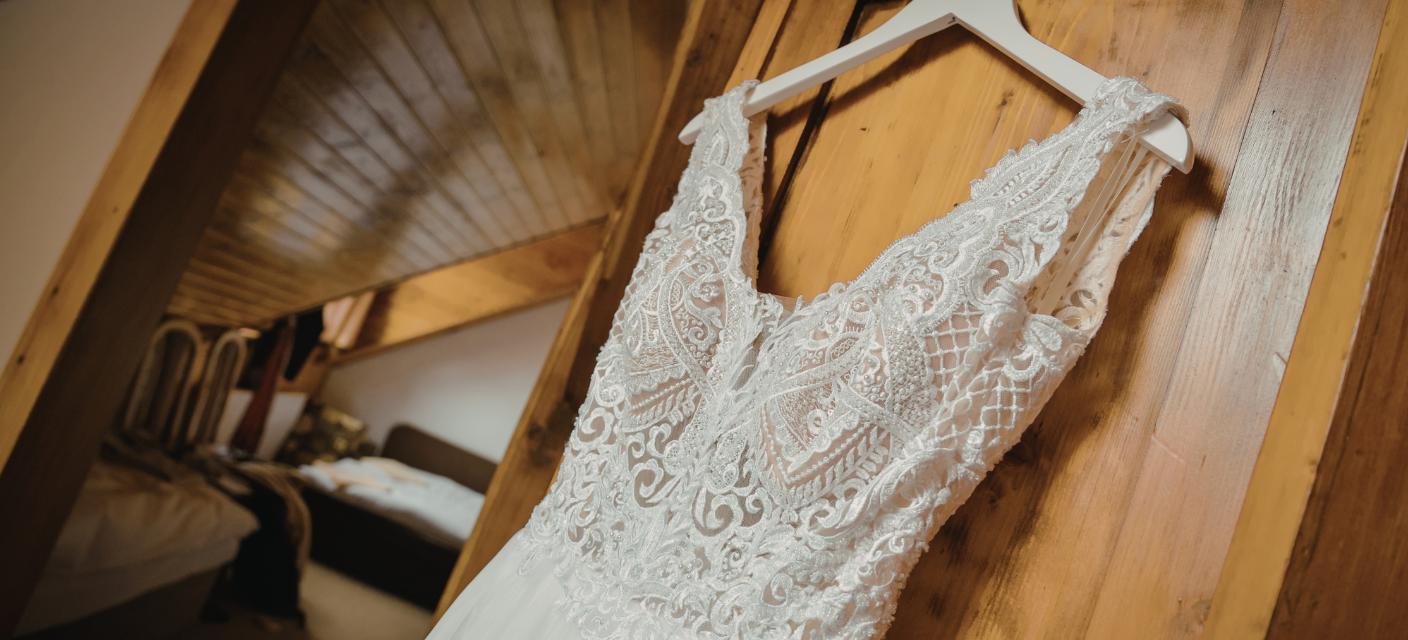
Your gown is basically a textile time capsule: delicate fibers, hidden stains, and structural details (boning, lace, beading) that don’t love heat, humidity, light, or pressure. Museums preserve historic clothing with boring-but-effective rules—borrow those, and your dress will stay bright, clean, and structurally sound for decades.
1. Waiting too long to clean it or assuming it “looks clean”
Why it’s a problem: Invisible stains (champagne, sugar, sweat, body oils) can darken over time as they oxidize—and once they set, they’re harder to remove without risking the fabric. Pollutants and off-gassing compounds can also accelerate degradation and discoloration in stored materials.
Avoid it:
- Get it cleaned/preserved as soon as you can (ideally within weeks, not months).
- Point out every spill you remember—pros can target treatment.
- If it’s heirloom-level sentimental (or you want “pass-down” longevity), consider professional preservation in addition to a standard clean.
2. Hanging it long-term–especially on a flimsy hanger
Why it’s a problem: Gravity is undefeated. Over months/years, hanging can stretch straps, distort the bodice, stress seams, and pull on beadwork/lace.
Avoid it:
- For long-term storage, store it flat in a supportive archival box instead of hanging. Flat storage is commonly recommended for long-term textile care.
- If you must hang it short-term: use a wide, padded hanger, support heavy skirts with internal ribbons/loops if present, and keep it out of light.
3. Storing it in plastic garment bags, vacuum bags, or sealed totes
Why it’s a problem: Sealed plastic can trap moisture (hello, mildew risk) and some plastics can off-gas volatile compounds that accelerate oxidation/hydrolysis—aka yellowing and weakening over time.
Avoid it:
- Skip sealed plastic bags for long-term storage.
- Choose a breathable, archival approach: acid-free box + acid-free tissue (or muslin/Tyvek garment bag designed for preservation).
- If you’re using a bin for convenience, don’t put the gown directly against plastic—buffer it in archival tissue/box first.
4. Using non-archival materials (regular cardboard, colored tissue, cedar chests)
Why it’s a problem: Ordinary cardboard and wood-based storage can introduce acids/pollutants over time; cedar chests are a classic “sounds romantic, ages terribly” storage method because wood can be acidic and can stain textiles.
Avoid it:
- Use an acid-free, lignin-free archival box and acid-free tissue to cushion folds and prevent abrasion.
- Choose neutral pH, unbuffered acid-free tissue, which is commonly recommended for general costume/textile storage.
- If the dress is already in a “preservation box,” confirm it’s actually archival-quality (not just a white cardboard box with a window).
5. Picking the wrong storage environment
Why it’s a problem: Textiles are highly sensitive to heat, incorrect humidity, pests, pollutants, and light. Damp spaces encourage mold and attract insects; light (even indoor light over time) contributes to fading and fiber damage.
Avoid it:
- Store in a cool, dry, dark, climate-controlled space. Think: interior closet in the main living area—not attic/basement/garage.
- Keep lights off around it; closed storage (boxes/cabinets) protects textiles from light and UV.
- Check it 1–2x/year: quick inspection for pests, moisture, or new yellowing is a standard “don’t be complacent” best practice even in professional textile storage. Please note: If your dress is already preserved, don’t open the box to inspect (you’ll need to re-preserve it if you expose it to the air). Inspect it instead through the viewing window.
TL:DR – Dress Storage Setup
If you want to keep your dress clean and beautiful for years and years:
- Clean/preserve the gown.
- Store flat in an acid-free, lignin-free box.
- Pad folds and bodice with acid-free tissue (neutral pH, unbuffered is a common go-to).
- Place the box in a cool, dry, dark interior closet—never attic/basement/garage.
- Inspect every 6–12 months.
Quick self-check (if your dress is already stored)
- Is it in plastic or vacuum-sealed? → Change that.
- Is it hanging and heavy? → Move to flat storage.
- Is it in regular cardboard or a cedar chest? → Rehouse it in archival materials.
- Is it in an attic/basement/garage? → Relocate to a climate-stable closet.
- Have you never opened it since the wedding? → Schedule a quick check.